On September 16, 2026, President Vladimir Putin delivered his televised address on the eve of the State Duma elections. The opening was purely administrative: which offices were being contested, and the fact that the campaign was unfolding during the “special military operation.” Then, in the same even tone, he noted that Donbas and Novorossiya would vote for the first time since their reunification with Russia. He didn’t pause or change his register; he simply moved on. Only afterward did the speech grow emotional, turning to soldiers’ courage, national unity, and threats to Russia’s sovereignty. Donbas and Novorossiya never came up again. By the time he invoked “the whole country,” they had vanished into it.
That absorption is the point. Putin referred to the residents (жители) of Donbas and Novorossiya (Донбасса и Новороссии), his shorthand for the four occupied regions Russia declared annexed in 2022. Rather than naming Donetsk, Luhansk, Zaporizhzhia, and Kherson as the Ukrainian oblasts they are, he regrouped them under two historical names, neither of which is a current administrative label. Donbas is the name of a coal-mining region; Novorossiya is imperial vocabulary, reaching back more than two centuries to Catherine II’s Novorossiysk Governorate. The names implied a historical claim; a single word stated it outright. Putin billed this as the first election since the territories’ reunification (воссоединения) with Russia, a euphemism that recast conquest as homecoming.
The setting is crucial. An ordinary parliamentary election, extended into occupied territory without so much as a change in tone, is not the footnote to the war that Putin seeks for it to be. Rather, it is the instrument of annexation itself, in its most mundane form. The referendums of 2022 announced the annexation. What makes it hold is duller: a redistricting map, a Central Election Commission (CEC) resolution, and enough patience to let the paperwork do the work of a border.
How Russia Turned Four Occupied Regions into Seven Duma Districts
In April 2025, Russia’s CEC carved seven new single-mandate districts out of occupied Ukraine, treating the regions as administratively indistinguishable from the rest of the country. With the number of districts fixed at 225, the new seats had to come from somewhere. The CEC’s official method was arithmetic: divide Russia’s registered voters by 225, then cut one district each from ten regions whose voter counts had fallen. However, according to Golos, Russia’s independent election monitor (defunct since July 2025, after its co-chair was sent to a penal colony), several of the eliminated seats had been held by the opposition, or what passes for it in Russia: the KPRF’s Maria Prusakova in Altai Krai, the LDPR’s Alexey Didenko in Tomsk, A Just Russia’s Yury Grigoriev in Zabaykalsky Krai. The population data, Golos found, did not explain which seats were cut. In Altai Krai, the district that disappeared was the one held by the opposition, even though it had lost the fewest people of any district in the region over the past decade. That is gerrymandering dressed as routine redistricting.
A district map needs voters, and in occupied Ukraine, Russia has manufactured those too. After Putin declared the four regions annexed in September 2022, residents were given one month to opt out of Russian citizenship. In April 2023, Decree No. 307 made those who refused it deportable as foreigners starting in July 2024. Decree No. 159, signed in March 2025, set a final deadline of September 10, 2025. Meanwhile, Yale’s Humanitarian Research Lab documented that medical care, social benefits, and jobs were being withheld from anyone without a Russian passport.
When the CEC drew the new districts, Donetsk’s election commission reported 1.65 million voters and specified that it had counted “persons who received RF passports as of January 1, 2025.” Those passport holders are the population of Donetsk’s three new districts. Residents who refused a passport were not only threatened with deportation. They were left off the electoral map.
Then came the machinery to make sure the new seats could actually be filled in wartime. On August 31, 2026, the CEC adopted a resolution reclassifying the occupied territories as “remote and hard-to-access,” the same designation used for Arctic villages and Siberian taiga settlements. That status authorizes early and mobile voting, with far less oversight than an ordinary polling station receives. Deputy CEC Chairman Nikolai Bulaev said the measures were meant for “more effective realization of voting rights for citizens in liberated territories, including our military personnel.” This drips with the same imperial justification as Putin’s: “liberated territories” (освобожденных территориях) which insists the territory was Russia’s to recover, not Ukraine’s to lose.
Seven new districts amount to just over 3 percent of the Duma’s 225 single-mandate seats. A skeptic might ask whether the occupied territories are really the main event, or a minor addition to an election that’s overwhelmingly about domestic Russian politics. But the election serves two functions, running Russia’s own vote and absorbing occupied territory, and the two don’t compete. The same redistricting that cut an opposition-held seat in Altai Krai created three in Donetsk. The second function is smaller, but it doesn’t need to be the biggest to be real. Nor is it passive. A deputy elected from occupied Donetsk casts real votes on Russian law, including laws about Donetsk.
Crimea, the Template
Putin’s address never mentioned Crimea. Donbas and Novorossiya got their line; Crimea, twelve years in, didn’t need one. Its absence is what the map has been working toward.
Since Crimea’s first Duma election in 2016, its electoral map has run on the petal (петальная) system: a regional capital sliced into several districts, each stitched to a wedge of surrounding countryside, “attached like flower petals.” Under this framework, Simferopol was split three ways, its urban vote diluted across three seats, none of them Simferopol’s alone. The system is the same one used across most of Russia, and in Crimea that consistency does the job. Ordinary administration is itself a claim of sovereignty.
Under international law, Crimea remains Ukrainian territory, and almost no country recognizes its annexation. Running Simferopol’s elections through the same machinery as undisputed Russian regions doesn’t reflect Crimea’s legal status. It attempts to build a new one, folding occupied territory into domestic administration until the line between the two is erased. Crimea’s voters were made the same way. Under the 2014 law Russia wrote to absorb the peninsula, every Ukrainian citizen living there was “recognized” as Russian unless they declared, within one month, that they wished to remain Ukrainian. It was the same clock the four regions were put on in 2022.
In 2025, Crimea’s map changed. Crimea and Dagestan were the only two regions in the country to abandon the petal system entirely, switching to what officials call the cluster (кустовая) scheme, which keeps municipalities whole and puts Simferopol in a single district. A regional election official described the change to Kommersant as “purely cartographic and mathematical work,” language built to sound like the opposite of a political decision.
But out of every region in Russia, only two got this particular rewrite, and both sit on the periphery: Crimea, seized by force, and Dagestan, which has repeatedly tested Moscow’s control, from the 2022 protests against mobilization to the 2023 riot at Makhachkala’s airport. Officials have not said why these two. If the redesign were just math, it would be a strange coincidence for it to land in exactly these places, and the obvious non-political explanations don’t hold up. The ten-year redistricting cycle redrew every region’s map but changed the method in only these two. Crimea kept its three districts, so no change in seat count forced the redesign. And if keeping municipalities whole were simply better administration, it would have reached Saratov or Krasnodar, which kept their petals.
Natalya Kiseleva, who directs the Crimean branch of the Civil Society Development Fund, a Kremlin-linked foundation, undercut the official narrative herself. The new map, she said, still leaves “certain difficulties” for United Russia candidates in Crimea’s other two districts, Yevpatoria and Kerch. Math doesn’t produce difficulties for a party. Politics does.
Crimea is what occupied Ukraine looks like after a decade. The first map gets drawn, then redrawn, then redrawn again. Each version is presented as routine, and each makes the occupation harder to tell apart from ordinary governance. The seven districts carved out of Donetsk, Luhansk, Zaporizhzhia, and Kherson in 2025 are only the first draft. Each revision will assume a little more firmly that the map is Moscow’s to draw.
The Count
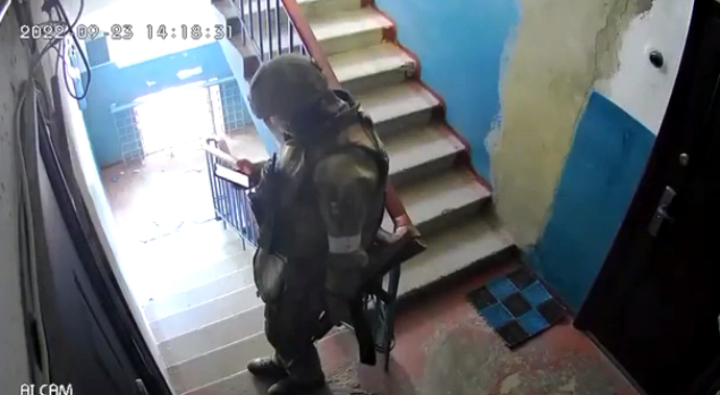
In 2022, Russia called referendums, and the UN described officials going door to door with ballot boxes, “accompanied by soldiers.” In 2026, Donetsk’s election officials went door to door again, accompanied by Russian police and National Guard troops (в сопровождении сотрудников МВД России и Росгвардии), according to Kommersant.
This time, Russia called it early voting. The results arrived on schedule. United Russia’s candidates won every district in Donetsk, Luhansk, and Zaporizhzhia. In Kherson, the party took 74.81 percent of the vote on a reported turnout of 74.61 percent, well above Russia’s national turnout of 59.8 percent.
This matters for whatever comes after the fighting. A ceasefire that froze the front line would leave Russia holding a political map that already extends past it, with districts drawn, deputies seated, and voters registered in places its army does not control.
Kherson’s Russian-installed government doesn’t govern from Kherson. A 2024 decree names Henichesk, a small town on the Sea of Azov, the region’s “temporary administrative center” (временным административным центром), citing “circumstances related to martial law and evacuation.” The decree doesn’t say whose army holds Kherson: Ukraine’s, since November 2022. The Russian-installed governor, Vladimir Saldo, has insisted Kherson “was, is, and always will be” the region’s capital. “Anything else,” he said, “is out of the question.” District No.187 was drawn, voted in, and counted over a capital Russia does not hold. The Russian army retreated from Kherson in 2022, but the administrative border never moved with it.