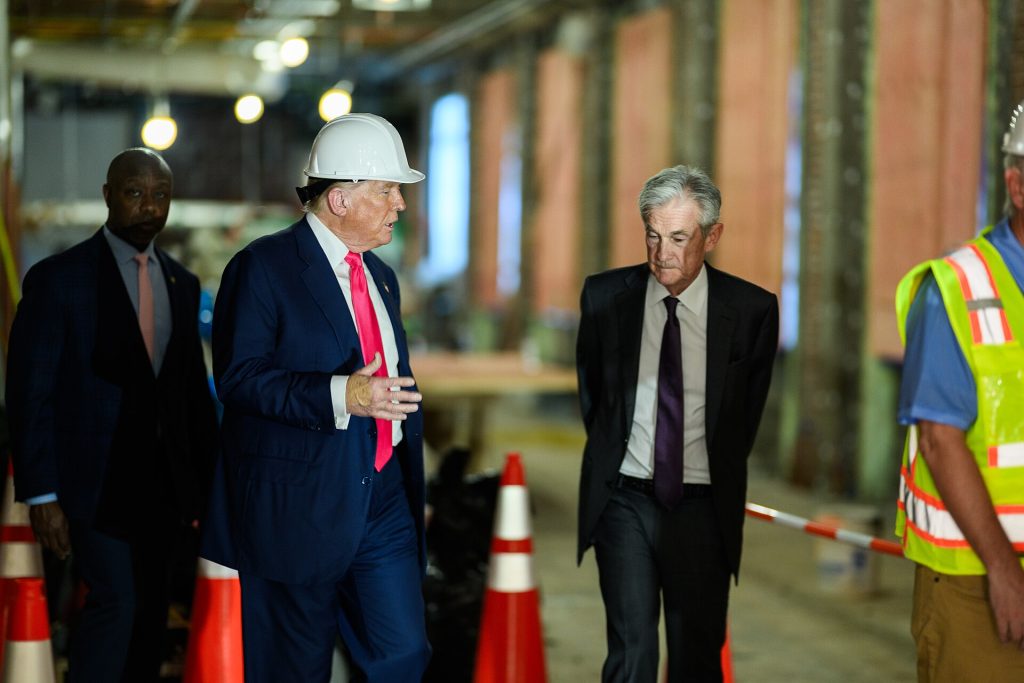
In early January, the Department of Justice issued the Federal Reserve (the “Fed”) multiple grand jury subpoenas regarding planned renovations for two Fed buildings in Washington, D.C. The renovations themselves are outstandingly banal: in a July 17 letter to the Office of Management and Budget, Chair of the Federal Reserve Jerome Powell specified the renovations, noting that the Fed planned to remove asbestos, update the building’s fire detection, and install an improved HVAC system. In contrast, the Trump administration has claimed that the Fed ostensibly mismanaged the funds and that Powell gave false testimony in regard to the renovation’s costs, leading to a criminal investigation of Powell.
Regardless of whether the Fed truly mismanaged its funds, it can hardly be argued that Trump’s swipe at Powell is due to supposed financial mismanagement. Rather, the Trump administration’s menace of the Federal Reserve serves as a slight to its independence, with the chief goal of removing Jerome Powell as its Chair. It cannot be argued that the president holds the constitutional authority to do so.
It is an open secret on Capitol Hill that Trump has wanted to remove Powell since at least July of last year. The reasoning is simple. By mandate, the Fed is tasked with maximizing employment and monitoring how much money is in the economy at any given time: as a gross oversimplification, more money in the economy causes interest rates to fall, making it cheaper for consumers to pull a mortgage, finance a car, buy government bonds, or loan money for a small business. Less money in the economy generally rears the opposite effect. The Fed bumps and nicks interest rates to ensure stable inflation and prices, which often cause negative effects in the short term but long-term predictability in the economy.
Resultingly, individual policymakers often butt heads with the Fed, which is purposefully isolated from the hotheadedness of Capitol Hill. The Fed’s seven governors serve overlapping, singular, fourteen-year terms, ensuring that governors hold their tenure over multiple Congresses and presidential administrations. Similarly, the Chair is chosen among already-sitting Fed governors, whose four-year term is separate from their term as a governor. And, because Fed governors are appointed and not elected, they do not feel the need to adjust monetary policy to appease constituents.
Still, voters often misappropriately attribute the injurious side effects of the Fed’s actions to individual policymakers. The Fed’s control of monetary policy indirectly affects issues that are most pressing to voters, such as grocery prices or gas prices. Because voters can’t expend their frustration at the Fed, they do so at the ballot box, whose candidates have public profiles that are much more prominent than those of the Fed’s governors. For example, in 1980, incumbent president Jimmy Carter swallowed the anger of voters after the Fed purposefully tanked the economy in the late ‘70s, leading to Ronald Reagan’s landslide victory in the election of 1980.
Suppose, then, what might happen if the president—or any individual policymaker, for that matter—were able to set interest rates instead of the Fed. Likely, they would create short-term booms to the economy by setting interest rates low, leading to bumps in approval ratings or popularity, but ultimately inciting an economic bust in the long-term. As demonstrated by his challenge to the Fed’s independence, that is the prerogative Trump wants to wield. He wants either himself or a loyalist to manipulate interest rates for short-term political clout, and dispatching Powell is the first step in doing so.
Still, it cannot be argued that the president maintains the constitutional authority to remove the Chair of the Fed. The argument typically espoused by unitary executive theorists holds that the president is able to dispatch any member of the executive branch, citing the president’s authority to devolve—and logically, deprive—executive power to lower officers. This power can be found in the Vestings Clause of Article II: “the executive Power shall be vested in a President of the United States of America.”
But it can hardly be argued that the powers of the Fed constitute executive power. The Fed is chiefly concerned with raising or lowering interest rates from time to time, but it cannot exercise executive power as it is traditionally considered: the Fed cannot execute laws, conduct diplomacy, command the military, grant pardons, or administer the bureaucracy. It is not a part of the executive branch, nor does that make it a hybrid “fourth branch” of government with a mandate to meddle in executive and legislative affairs. It is perhaps best described by the Supreme Court’s emergency judgement in Trump v. Wilcox: “the Federal Reserve is a uniquely structured, quasi-private entity that follows in the distinct historical tradition of the First and Second Banks of the United States.”
But even if the Fed did exercise executive power, the Fed’s mandate to control monetary policy is granted by statute, not by devolution, through the Vestings Clause. The Federal Reserve exists because Congress passed the Federal Reserve Act in 1913, not because the president ordered the Fed’s existence. Recent litigation concerning whether the president can remove a member of the Federal Trade Commission demonstrates how the president may not have inherent authority to remove members of the executive branch if their offices were created by statute. Thus, it is logical to conclude that members of the Federal Reserve are likely exempt from dismissal at the president’s whim.
The very fact that a president has threatened the Fed’s independence in such a boisterous manner should be of enormous concern to the average American. Aside from disregarding its constitution, nothing can more effectively crumble the stability of a developed country than political control of its central bank. And, to a reasoned observer, that seems to be what the president wants.