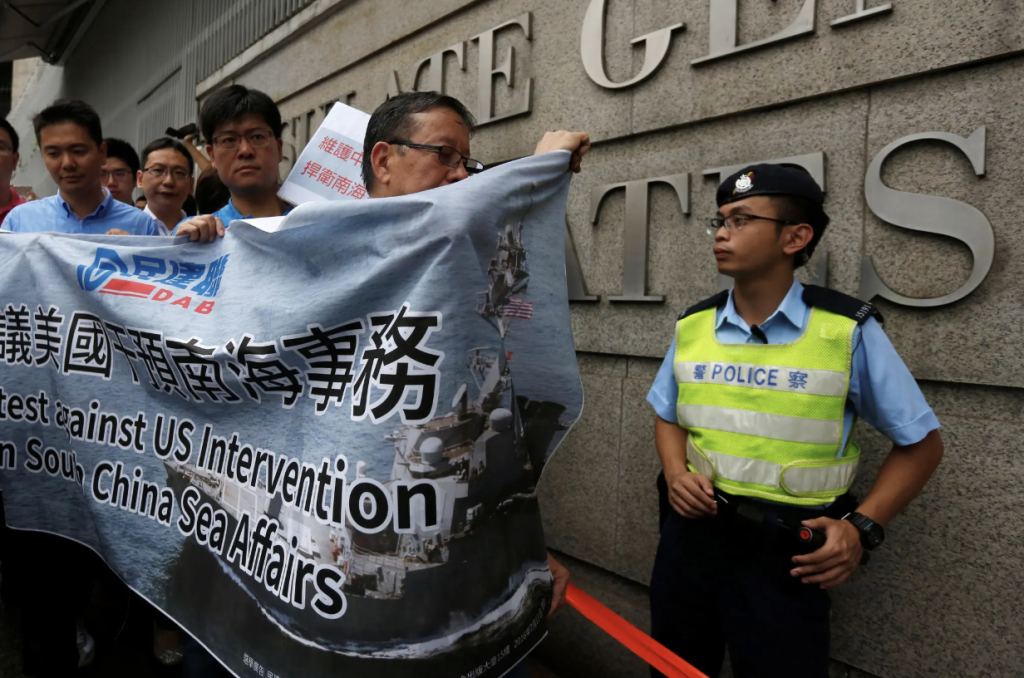
The South China Sea is home to global shipping routes, well-established fishing grounds, and undersea petroleum resources coveted by regional and international powers. It is an arena for political turmoil, with China, the quickly expanding regional hegemon, attempting to claim sovereignty over navigation and resource extraction within the sea. China’s claims are directly challenged by the assertions of local nations, including Vietnam, Malaysia, and the Philippines, as well as global powers and institutions including the United States and the United Nations. Nevertheless, China has maintained and routinely reinforced its territorial claim over the South China Sea, with measures including, but not limited to, artificial island creation, militarization, and the policing of foreign vessels.
The question remains: what does China look to gain from imposing control over the South China Sea? While common explanations emphasize the protection of natural resources, the investigation of Chinese policy in the region can be further understood through the impact of “popular” nationalism. This nationalism can be seen in domestic politics, which results in Chinese overexpansion in the South China Sea and its islands.
Widely accepted interpretations of China’s stance over the South China Sea center around the region’s extensive natural and strategic resources. The sea holds “proved” reserves of nearly 40.3 trillion cubic feet of natural gas and 3.6 billion barrels of oil, with analysts estimating almost quadruple that amount in approximated unproved reserves. The sea is also home to well-known fishing, coral, and undersea water resources. In addition, the sea contains tactical transport routes for petroleum carriers and foreign military vessels. Nearly 50% of the world’s oil tankers travel through the sea, as well as up to one-third of the globe’s maritime commerce. However, while China has continued to express interests in expanding oil production, the nation has also become a leading figure in the international green energy market, producing goods ranging from electric vehicles to solar panels. The nation has also increasingly looked to decrease domestic emissions, as the result of popular public support for environmental regulation. China’s 5-year plan set in March of 2026, which designated domestic gas consumption to peak by 2030, illustrates the nation’s slowing demand for oil.
Most Chinese actions defending territorial claims within the South China Sea – the dredging of artificial islands to enhance Chinese claims in foreign Exclusive Economic Zones (EEZs), the militarization of small, uninhabited islands claimed by alternate Southeast Asian nations, and the patrolling of non-national civilian actions by Chinese coast guards – have also not been directly aimed to inhibit foreign actions in the South China Sea. Instead, these actions have centered around strengthening Chinese territorial, political, and legal jurisdiction in the disputed waters. Increased Chinese presence in the South China Sea has been met with escalated responses by regional claimants, either through international frameworks or competing militarization, as well as further US attention on the region to protect American logistical interests and local allies. These actions have increased, rather than decreased, international attention on the abundant resources and tangled sovereignty issues within the sea, resulting in challenges to Chinese strategic interests and subverting the perceived sole intention of resource protection.
An alternative perspective emphasizes the impact of internal voices as a cause for international Chinese action. In the wake of the 1989 Beijing student uprising movement, the ruling regime, the Chinese Communist Party (CCP), began to lean heavily on new patriotic campaigns as a form of propaganda to maintain state legitimacy. These initiatives focused heavily on the “century of humiliation,” or the era of foreign imperial influence over China spanning the 19th and early 20th century, to emphasize the CCP’s role in righting historic wrongs. As a result, the CCP linked its own legitimacy to the maintenance of state strength, making nationalistic issues central to the government’s survival prospects. This connection resulted in increased CCP commitment to issues of nationalistic importance. Today, the CCP’s patriotic reforms have birthed an independent branch of “popular” nationalism in citizens. These nationalists have been seen to challenge the state’s own perspectives, exhibiting an organic form of national pride — with examples including widespread protests following Japanese acquisition of the Diaoyutai/Senkaku Islands and national pressure towards reunification with Taiwan. In such protest movements, extremist civilian passions for a strong, domineering China have clashed with official state policies. In turn, “popular” nationalism pressures Chinese officials to consider the reactions of domestic citizens when making decisions on issues with historical or patriotic significance.
Correspondingly, China’s stance on the South China Sea is grounded in historical precedent. Some scholars tie the country’s claims back to imperial trade routes and longstanding regional influence — even using the trips of Ming Dynasty explorer Zheng He as evidence for China’s distinctive familiarity with the region. This history served as the basis for depictions of the South China Sea as Chinese sovereign territory, resulting in the eventual creation of the eleven-, then nine-, dash cartographic line used to assert the country’s claim to the region. Similar to the historically-based hostilities directed at Japan and Taiwan, the CCP’s stance on the South China Sea aligns with enduring cultural narratives inseparable from the CCP domestic image. As a result, the centrality of nationalism as a pillar of the CCP’s popular support pressures China to maintain power in the South China Sea, with the goal of signaling strong state sovereignty for domestic audiences.
One specific example of Chinese nationalism in the South China Sea comes from the 2012-2016 China–Philippines standoff over the Scarborough Shoal. In 2012, in response to the Philippines’ arrest of Chinese fishermen found to be illicitly harvesting endangered species in the region, the Chinese government deployed naval resources to protect Chinese nationals and block further Filipino access to the now-Chinese-controlled Scarborough Shoal – an uninhabited island located within both China’s nine-dash line and the Philippines’ EEZs. A year later, the Philippines brought the case to the Hague Convention’s Permanent Court of Arbitration for settlement. China refused to participate in the proceedings, asserting that the Court’s decision would not be binding. While the Court decided in the Philippines’ favor, ruling in 2016 that China’s nine-dash line had “no legal basis” and that China had violated the Philippines’ rights by interfering within the Philippines’ EEZ, the ruling has remained unenforceable and the CCP continues to occupy the Shoal into 2026.
During the standoff and arbitration, public opinion polls showed a Chinese populace that was explicitly supportive of patriotic claims to the sea. In 2013, 91 percent of Chinese survey participants held confidence in China’s nine-dash line claim to the South China Sea. Further, 62 percent of respondents supported UN arbitration, which could be seen as a result of popular conviction in their country’s claims. These findings depict how longstanding state rhetoric had permeated through Chinese society to become common belief, allowing for such ideals to evolve into rallying points for local, non-state movements. Case in point, the Court’s outcome — a distinct loss for China — was met with robust online outcry, pushing the government to censor popular internet chatboards, such as Weibo, in order to preserve civil stability. The censorship of such opinions reflected the domestic pressure placed on the CCP by “popular” nationalists, and government fear of such factions when policy does not live up to nationalist expectations. The rationale behind continued Chinese occupation of the Scarborough Shoal is therefore tied to the prevention of Filipino reclamation of the islands, as to limit nationalist outcry within China over state failures to maintain patriotically-imagined international strength and territorial sovereignty.
China’s actions in the South China Sea may best be explained by the rise of “popular” nationalist sentiment, which is central to national public support and influences the state into aggressive action to protect patriotic interests from competing claimants. These patterns can be clearly seen in state and society reactions to the 2012 dispute and subsequent 2016 arbitration over the Scarborough Shoal. The centrality of the South China Sea to Chinese nationalist rhetoric and state legitimacy implies continued difficulties for negotiators to find common ground and come to de-escalatory solutions within the sea. In the future, supplementary public opinion studies could help analysts understand the extent and depth of “popular” nationalistic views in the Chinese public. Such findings could assist analysts’ attempts to understand and predict China’s international actions based on the nation’s domestic climate.