Introduction
Throughout the history of the nation, Americans have been told that their democracy is the most resilient in the world. They have been fed the narrative that the system of checks and balances, the separation of powers, an independent judiciary and a deliberative legislature, would sustain itself against threats. This promise has been the precipice upon which American democracy has flourished.
What political scientists are now documenting, however, is that those assurances were always contingent on something no constitutional text could guarantee: the willingness of those in power to honor the norms that hold the system together. That willingness is currently eroding across all three branches of the federal government simultaneously, and the United States is experiencing democratic erosion at a scale and speed without precedent in its modern history.
What is Democratic Erosion?
Political scientists distinguish democratic erosion from the more dramatic and easily identifiable ruptures from the past, such as coups, electoral annulments, and declarations of martial law, precisely because erosion happens through legal and quasi-legal channels rather than in open defiance of them. Scholars like Nancy Bermeo and Steven Livitsky have described democratic erosion as a process in which elected leaders hollow out democratic institutions incrementally, using the very legal authority those institutions grant them, until the substance of constraint on power disappears. Because this process is gradual and diffuse, it cannot be encapsulated in a single dramatic event. This is why researchers rely on composite indices: aggregate measures that break “democracy” down into sub-components, and track how each moves over time, both independently and relative to the others. For example, V-Dem’s composite 2026 global democracy report recorded the largest single-year drop in American democratic standing in their dataset’s history, with the United States falling from 20th to 51st place on their global ranking. They flagged the United States as one of the most rapidly backsliding democracies among wealthy nations.
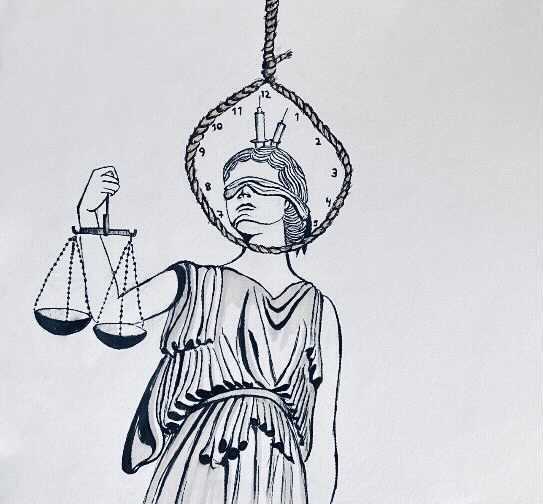
A composite approach is particularly suited to the current moment because it captures exactly what makes 2025 and 2026 distinctive, in that it is not that one branch has failed to check the others, but that the sub-indices for all three branches are declining in the same direction and at the same time. Read individually, a given executive action, congressional abstention, or judicial deference might be explained away by ordinary political functions. Read together, they describe a simultaneous erosion of the checks and balances that are in place to constrain each branch from imposing on the others.
What makes this moment categorically different from earlier periods of democratic stress is that erosion is occurring simultaneously across all three branches of the federal government. Together, these branches describe not just abstract trends but the specific conditions present in the United States today: Intentional agency, partisan complicity, and executive overreach.
The Executive Branch
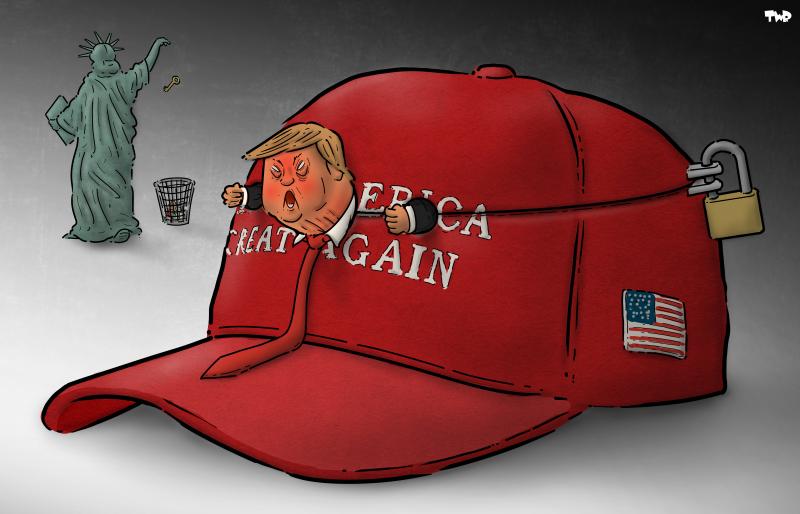
The executive branch has pursued an “aggressive and compressed agenda of executive aggrandizement,” or the simultaneous targeting of horizontal oversight institutions, civil servants, and independent agencies. Since January 2025, the Trump administration has removed 18 inspectors general from cabinet departments without cause, issued 292 executive orders, abused the bureaucracy to rapidly centralize authority, and deployed the rhetoric of emergency powers to sidestep congressional appropriations. By usurping the traditional means for passing laws, removing elected officials, or carrying out endowed executive powers, the Executive Branch has eroded the process of checks and balances and consolidated power to President Trump. This poses an incredibly serious risk for the future of our democracy that is only being compounded by the erosion taking place in the other two branches.
The administration has also significantly misused executive power to posture on the global scale and express warmth towards strongmen, normalize connections with political figures the United States has historically treated as adversaries or pariahs, and defer from allied leaders. For example, with longstanding US adversary, Kim Jong Un, Trump has continued the personal-rapport diplomacy of his first term, describing an ongoing correspondence and telling reporters in August 2026 that he intended to meet with Kim again, saying “the fact that I get along with him, that’s a good thing.” Taken with the alienation of former allies via Trump’s “America First” funding overhaul (i.e.: funding cuts to the UN, strains with NATO, and trade and economic conflicts), this appears to reflect a broader realignment in which personal relationships between leaders, rather than institutions, alliances, or legal norms, is increasingly determining international outcomes.
Domestically, immigration enforcement has produced some of the most direct evidence of the executive branch operating outside of normal legal constraints and checks on their power. In May 2025, the Department of Homeland Security (DHS) implemented a secret policy authorizing ICE agents to enter and search homes without judicial warrants, a stark departure from decades of prior practice. The policy spawned a number of state-based lawsuits, alleging that masked, armed agents entered homes without cause, detaining US citizens who repeatedly identified themselves as such, and using excessive force including riot munitions and chemical irritants against bystanders.
During “Operation Metro Surge” in Minneapolis-St. Paul in December 2025-January 2026, thousands of armed and masked federal agents were deployed to the Twin Cities. The Minnesota Attorney General’s lawsuit alleges undue enforcement at schools, medical facilities, places of worship, and funeral homes, racial profiling based on accent and skin color, and the shooting death of a bystander, Renee Good, by a DHS agent. Compounding the due process concerns, the Cato Institute reported that just 5 percent of those detained in the broader enforcement push had been convicted of a violent crime, while 73 percent had no criminal conviction at all, numbers DHS as well as Donald Trump himself have heavily disputed without offering their own. The bottom line is that domestically and abroad, the executive branch, under the guidance of President Trump, has drastically departed from any and all precedented norms, common law, and constitutional checks on executive powers.
The Legislative Branch
The legislative branch has largely abdicated its constitutional role as a check on executive power. Not only has it merely failed to defend its enumerated powers, Congress has, on occasion, handed it over willingly. What we have witnessed recently is a Congress that, when faced with the most aggressive expansion of executive authority in modern American history, has largely chosen to look away. The longest government shutdown in US history, 43 days in Fall 2025, made this structural cowardice visible in real time. This was not simply a standoff between two competing governing visions or good-faith gridlock. And despite being a co-equal branch of government that is constitutionally empowered to control the federal “purse,” Congress surrendered that power after a weeks-long standoff with the very branch it is meant to oversee.
This process runs even deeper than any single spending fight. Congress has not meaningfully investigated the administration’s defiance of court orders. It has not moved to codify the democratic norms Trump is violating; it has not exercised its subpoena power, confirmation power, or contempt power in any meaningful way to restrain executive aggrandizement. This matters for a reason that goes beyond partisan scorekeeping. A legislature that cannot defend its own institutional prerogatives cannot defend the rights of its citizens. If Congress will not protect its own authority, it will not protect yours. And when future administrations of any party come looking for the precedents that justify expanding executive power, they will find them here, in the silence and deference of this Congress. This continuous failure on behalf of Congress to uphold their responsibility to their constituency, as well as the Constitution, continues to exacerbate democratic erosion.
Congressional war powers offer perhaps the starkest example of this pattern, precisely because Article I gives them sole authority to declare war. When Trump launched strikes on Iranian nuclear facilities in June 2025 without congressional authorization, the Senate voted down a war power resolution to check his overreach of power. Then, when it escalated into a sustained bombing campaign the following spring under operation “Epic Fury,” Congress tried and failed a fourth time to pass a war powers resolution. When the War Powers Resolution’s 60-day statutory deadline for ending unauthorized hostilities arrived on May 1, 2026, the administration simply declared that a temporary ceasefire had “terminated” the operation and paused the clock, despite continued US naval deployment. Congress simply accepted this answer without forcing the issue.
A similar pattern followed Trump’s unilateral military action to capture Venezuelan president Nicolás Maduro without congressional authorization, where a war powers resolution narrowly failed as well. None of this is unprecedented in isolation; Presidents since Nixon have chafed slightly against the War Powers Resolution statutes, and Congress has been ceding war-making authority periodically for some time. However, the compounding effect of a Republican-controlled House and Senate declining to reassert one of Congress’ most explicit powers four separate times in one year is a glaring problem. One that symbolizes a legislature that has stopped bothering to object.
The Judicial Branch
The judicial branch faces perhaps the most acute threat and may be the most clarifying case study in what current democratic erosion actually looks like. The Trump administration has defied or circumvented court orders in 57 out of 165 adverse rulings, meaning they chose to ignore or work around binding court orders in 57 different instances. The question is no longer whether judges are willing to rule against this administration, but whether those rulings mean anything at all. And the administration did not stop there. When a federal judge in Maryland blocked immigration and deportation enforcement, the administration sued the entire federal district court of Maryland and proceeded to call for the impeachment of any federal judge who ruled against it.
These are not ordinary legal tactics. They are attempts to punish the judiciary for exercising its constitutional functions. The administration is sending a message: judges must understand that ruling against Trump’s administration carries heavy institutional and personal costs, marking a direct assault on judicial independence. When the branch charged with interpreting the law can no longer enforce its own judgments, the rule of law becomes a mere suggestion. We should not comfort ourselves with the idea that the courts are “holding.” Some courts are ruling correctly and bravely, but a judge who issues a correct ruling that is then openly defied has not checked executive power, they have illustrated the limits of the judiciary.
The Supreme Court presents a different problem than that of the district or circuit courts under direct assault. During his first term, Trump appointed three justices (Gorsuch, Kavanaugh, and Barret), giving the Court a 6-3 conservative supermajority that no other modern president has assembled in a single term. Combined with lifetime tenure, this means the ideological composition of the nation’s highest court will be locked into this majority for generations—a structural feature of the Constitution that has become presently devastating with an extremist party filling vacancies that entrench a durable majority. The implications of his first term actions have arisen in the Court’s handling of Trump’s second-term agenda. Acting largely through its emergency, or “shadow” docket, the Court sided with the administration in 24 or 28 emergency applications, permitting the firing of federal employees, Trump’s assertion of control over independent agencies at will—overturning the 91 year precedent set by Humphrey’s Executor v. United States, a ban on transgender military service, and deportation to “third-countries” to which deported migrants had no ties. In other words, for most of 2025 and 2026, the Court functioned less as a check on the executive than as a reliable accelerant for it. The facts speak for themselves: a 24-4 record in favor of the administration is an enormously unprecedented shift in the Court’s willingness to check executive power.
Why this Time is Different
Many citizens will push back on this assertion and note that the United States has survived democratic stress before: Reconstruction’s violent rollback, McCarthyism, or Watergate are fitting examples. What distinguishes the present moment is not the presence of a single norm violation but the simultaneity and intentionality of norm erosion across the entire constitutional architecture, combined with a public primed by polarization to rationalize it.
This is the pattern scholars of democratic backsliding have identified in other nations such as Hungary under Orbán or Turkey under Erdoğan. Each of those countries had institutions and constitutions. And they all had citizens who believed the system would correct itself. It did not, because by the time the majority understood what was happening, the tools for correction had already been irreparably eroded.
The United States is not yet these nations, but it is further down that road than it has ever been. American democracy is backsliding, and it is doing so across every branch, all at once. And the window for course correction via elections, the courts, a legislature willing to defend its own authority, and the correct implementation of checks and balances, is not unlimited.