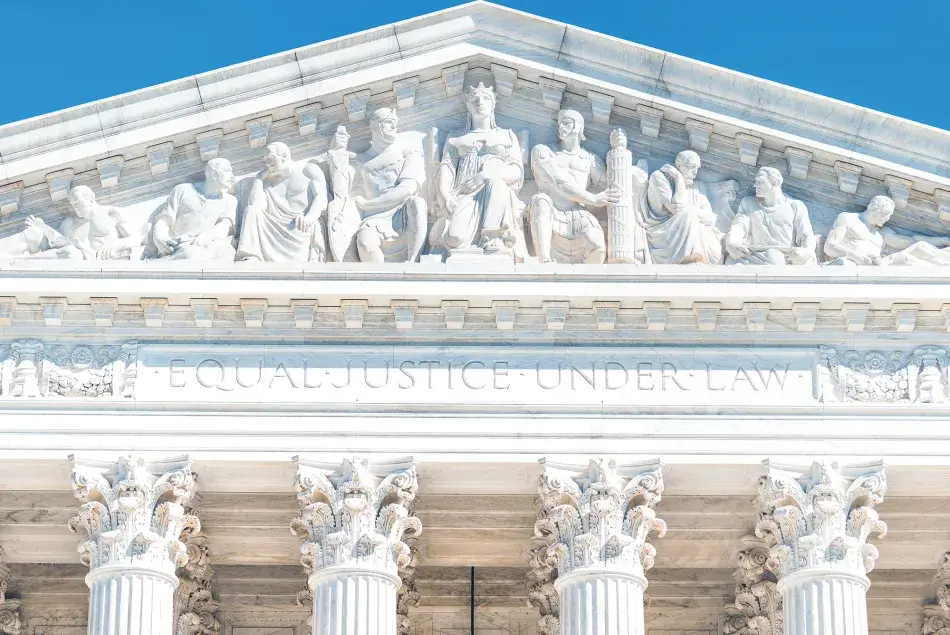
The promise of equal justice under law, rooted in the Constitution and reflected in the Fourteenth Amendment’s guarantee of equal protection, is a foundational principle in the United States — but access to that justice remains deeply unequal. Even though legal rights are formally granted, their enforcement depends on factors such as access to professional representation, education, and income. In reality, the American legal system operates more like a tiered marketplace, where meaningful participation — and the likelihood of favorable outcomes — is closely tied to one’s ability to afford legal representation, rather than functioning as a universal safety net. This illustrates the paradox in American democracy: equal rights exist in theory, but their enforcement is frequently conditioned on access to counsel and financial resources.
Civil court proceedings reveal these inconsistencies most clearly, particularly in the stark divide between criminal and civil legal protections within the legal system. Unlike criminal cases, where individuals have a constitutional right to counsel, civil cases do not guarantee legal representation, protection against self-incrimination, or access to appointed experts and procedural safeguards. Although the justice system often neglects them, civil cases such as eviction hearings, custody battles, benefits determinations, and record-sealing petitions can significantly affect a person’s economic and social stability. In the absence of personally acquired legal counsel, individuals are expected to represent themselves. Although some receive limited assistance through legal aid organizations, law school clinics, or unbundled legal services, they are chronically underfunded, unevenly distributed, and inaccessible to those who need them most. As a result, partial or short-term assistance often substitutes for full representation in proceedings with long-term consequences.
The Civil Justice Gap
The civil justice gap refers to the significant imbalance between the legal needs of low-income Americans and the resources available to meet those needs. Research consistently demonstrates that civil legal needs are not met, not because claims are meritless, but because legal aid organizations are overextended and underfunded. Courts often treat self-representation as a workable substitute, framing it as a matter of efficiency or individual accountability.
Yet, legal systems are not neutral environments. Court procedures involve technical rules, strict deadlines, and legal jargon that presume professional training. It is unreasonable to expect people without legal knowledge to navigate these systems; it institutionalizes inequality while preserving the appearance of due process. The complexity of the law functions as a gatekeeping mechanism, creating disadvantages for those without resources while creating privilege for those fortunate enough to possess them.
These barriers disproportionately affect populations already experiencing structural disadvantage. Veterans, immigrants, individuals with low incomes, and those with criminal records frequently encounter legal proceedings that offer minimal support. For these groups, legal challenges rarely exist in isolation. Instead, they intersect with broader forms of instability, including housing insecurity, limited employment opportunities, and unequal access to health care.
Procedural obstacles can derail the efforts of immigrants navigating administrative law, veterans seeking benefits, or individuals attempting to seal records. When legal institutions fail to account for these compounding vulnerabilities, they do more than withhold support — they actively reproduce social marginalization. In this way, the legal system becomes yet another site where inequality is reinforced rather than remedied.
Access to Justice as a Democratic Issue
Inequitable access to due process has far-reaching consequences that extend well beyond isolated court cases or personal conflicts. As a visible manifestation of the rule of law, courts often represent the most direct and palpable interaction between citizens and the state. Public trust in the legal system begins to decline when these institutions seem unapproachable, overly complicated, or primarily punitive, particularly for those with limited financial or social resources. In addition to failing the impoverished, marginalized, and unrepresented, a justice system that consistently disadvantages them also compromises the system’s legitimacy as a democratic institution.
Democracy requires more than the formal recognition of rights enshrined in constitutions or statutes. It is contingent upon citizens’ ability to effectively and equally exercise those rights. Justice is perceived as transactional rather than guaranteed when access to it is dependent on financial resources, legal expertise, or expert counsel. Under such circumstances, rulings increasingly favor socioeconomic status rather than the merits of a case, meaning that political equality loses much of its substantive significance. This discrepancy signals to the public that the legal system’s neutrality is aspirational rather than operational, weakening its legitimacy as an impartial democratic institution.
This sense of exclusion fosters legal alienation, in which individuals come to view the legal system as distant, adversarial, or irrelevant — a perception that often spills over into broader political disengagement, increasing mistrust in public institutions and weakening civic engagement. Democratic norms deteriorate, and people lose faith in government when they no longer believe the state can or will adequately defend their rights. When legitimacy erodes, compliance with the law becomes fragile, civic participation declines, and democratic institutions lose their ability to function as credible arbiters of social conflict. Therefore, guaranteeing equal access to justice under the law is essential to maintaining democratic legitimacy and public trust, not merely a question of legal efficiency or procedural fairness.
Rethinking Legal Access
Instead of relying solely on symbolic commitment, structural reform needs to address the access-to-justice crisis in civil cases, where legal representation is not guaranteed. Practical steps toward a more equitable system include increasing legal aid funding, creating a civil right to counsel in high-stakes cases such as housing and family court, streamlining procedural requirements, and implementing automatic record-sealing policies for nonviolent offenses. These changes reflect political priorities rather than radical shifts.
The persistence of the civil justice gap is not inevitable. Instead, it is the result of deliberate policy choices that treat legal protection as a private service rather than a public good. As long as access to justice remains contingent on wealth, the promise of equal protection under the law will remain largely rhetorical.
A legal system that excludes many from justice cannot truly serve the people. Justice in the United States will remain a privilege instead of a right until access becomes a democratic obligation rather than a commercial good.