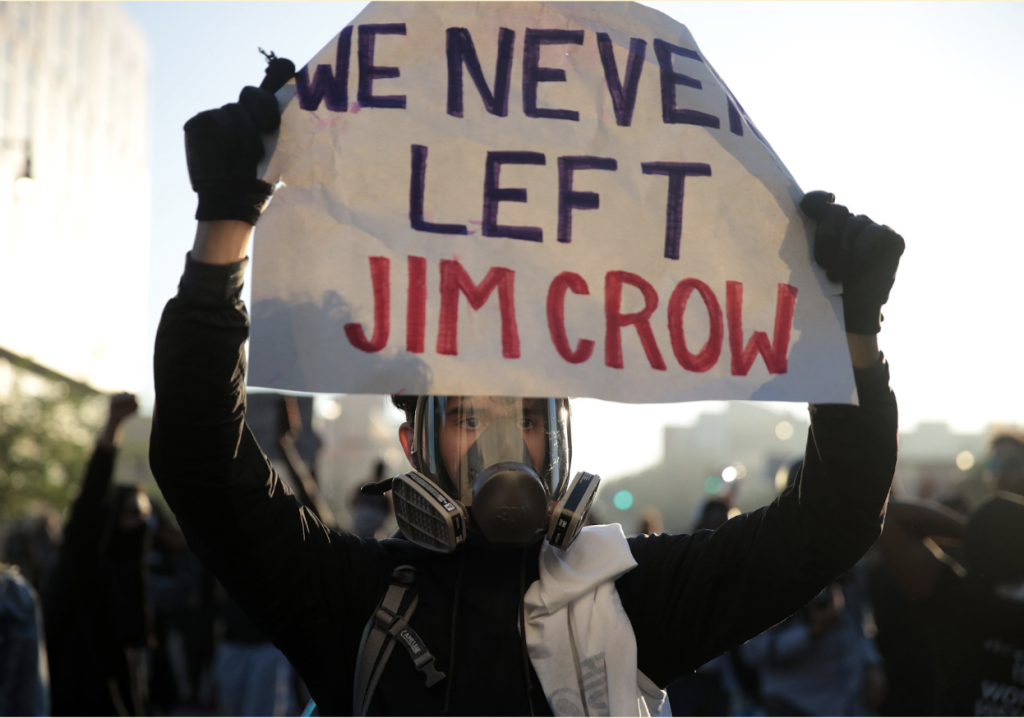
American law is often presented as neutral, objective, and detached from history. Courts regularly insist that past injustice has little relevance to present-day doctrine, framing racism as a problem that existed once but has since been corrected. Yet, many of the legal rules that govern policing, punishment, and participation in the justice system today were shaped directly by slavery, Reconstruction, and Jim Crow. Doctrines such as qualified immunity, sentencing discretion, and jury selection did not emerge in a vacuum. They evolved from explicitly racist legal frameworks designed to control Black Americans, and the failure of legal institutions to confront this history allows racial inequality to persist under the appearance of fairness.
Qualified Immunity and State Protection
Qualified immunity illustrates how modern legal principles continue to protect state violence while ignoring its historical foundation. These articles shield police officers and other officials from civil liability unless they violate clearly established constitutional law, a standard that makes accountability rare. Studies show dismissal on qualified immunity grounds in only about 3–4% of cases and grants in fewer than 20% of motions raising the defense.
Although qualified immunity is often justified as a good-faith protection for officials, its function closely mirrors earlier legal protections afforded to slave patrols. During slavery, patrols were legally authorized to stop, search, beat, and kill enslaved people with little to no consequence. After the Civil War, Southern states carried these practices forward through Black Codes and vagrancy laws that criminalized everyday Black life and empowered law enforcement to police Black communities aggressively.
In practice, this standard has repeatedly blocked civil suits arising from police violence. Modern courts rarely acknowledge this lineage. Instead, they treat qualified immunity as a technical rule divorced from its history. In 1982, the Supreme Court formalized this doctrine through Harlow v. Fitzgerald, which holds that officials are immune unless they violate established law. Even in cases involving extreme misconduct, courts have dismissed claims because no prior case involved identical facts. Following the murder of George Floyd in 2020, civil suits against officers nationwide encountered the same barrier, with judges emphasizing precedent over accountability. By limiting their analysis to whether an officer’s actions were objectively reasonable under existing precedent, courts avoid engaging with the broader racialized history of policing. This allows doctrines rooted in state power to continue to shield violence rather than restrain it.
Racialized Sentencing
Judicial sentencing discretion, the authority judges have to decide the length and type of punishment within a legally permitted range, similarly reflects how racial hierarchy has been embedded into modern punishment. During the Jim Crow era, judges openly exercised discretion to impose harsher sentences on Black defendants while granting leniency to White defendants accused of similar crimes.
Convict leasing systems, which effectively re-enslaved Black men through criminal punishment, relied heavily on discretionary sentencing to supply forced labor. Although modern sentencing laws no longer mention race, the effects of this discretion remain unequal. According to the U.S. Sentencing Commission, Black men receive federal sentences that are approximately 19 percent longer than those imposed on White men for similar offenses, even after controlling for offense severity and criminal history. Black Americans are far more likely to receive longer sentences, particularly in drug cases, even when controlling for offense severity and criminal history.
The Supreme Court’s 1987 decision in McCleskey v. Kemp demonstrated how the law dismisses history when it is most relevant. In that case, the Court acknowledged strong statistical evidence showing that Black defendants who killed White victims were far more likely to receive the death penalty, yet it ruled that these disparities were constitutionally irrelevant without proof of intentional discrimination. This decision effectively insulated systemic racism from legal challenge, treating racial inequality as an unfortunate coincidence rather than the predictable outcome of a historically biased system. Today, sentencing discretion continues to operate within this framework, allowing racial disparities to persist while courts insist that the law itself is neutral.
Jury Exclusion
Jury selection provides another clear example of how exclusion has evolved rather than disappeared. For much of American history, Black citizens were explicitly barred from jury service to ensure that legal decision-making remained in white hands. Even after formal exclusion was declared unconstitutional, prosecutors continued to remove Black jurors through peremptory strikes, which allow attorneys to dismiss jurors without providing a specific explanation.
Through Batson v. Kentucky (1986), the Supreme Court ruled that race-based jury strikes violate the Constitution, but the standard it established has proven largely ineffective. Prosecutors can offer vague, race-neutral explanations, such as demeanor or body language, which courts routinely accept. Empirical studies estimate that Batson challenges succeed in only about 1–2% of cases nationwide. This pattern of exclusion raises serious concerns about the legitimacy of the justice system and may contribute to racial disparities in verdicts and sentencing, reinforcing long-standing mistrust among Black Americans.
Modern cases reveal the persistence of this practice. In 2019, a federal court found that prosecutors in Houston had systematically excluded Black jurors for decades, yet many convictions were left intact because the Batson standard places a heavy burden on defendants to prove intentional discrimination, which courts rarely find. While Ramos v. Louisiana of 2020 acknowledged that non-unanimous jury verdicts were rooted in Jim Crow efforts to weaken Black juror influence, the decision applied only prospectively and did not remedy past convictions. Courts continue to treat modern jury discrimination as isolated misconduct rather than part of a historical pattern.
Across these doctrines, a consistent theme emerges. The law recognizes slavery and segregation as moral wrongs, but refuses to meaningfully incorporate that history into contemporary legal analysis. Courts demand proof of individual intent rather than acknowledging structural design, allowing racial inequality to persist without explicit discrimination. By treating history as irrelevant, the law avoids confronting the ways its own rulings were built to serve racial hierarchy.
The consequences of this legal amnesia are visible today. Qualified immunity limits accountability for police violence, sentencing discretion fuels mass incarceration, and jury selection practices exclude marginalized voices from the courtroom. These outcomes are not accidental. They are modern expressions of a legal system that has never fully reckoned with its past. If American law is serious about justice, it must abandon the fiction of historical neutrality. Legal doctrines do not exist outside of time; they carry forward the assumptions and power structures of their origins. Treating history as irrelevant does not erase its influence, it conceals it. Only by confronting how slavery and Jim Crow shaped the foundations of modern doctrine can the justice system begin to move toward genuine equality under the law.