Conflict is the world’s greatest threat to stability.
As multilateral institutions atrophy and hegemonic powers embrace militarism, small and middle powers (SMPs) must navigate a precarious future. Yet, the dissolution of unipolarity also presents opportunities for SMPs to lead diplomatic innovation by leveraging strategic coalitions with civil society and with each other. Should these states reject isolationism and invest in collective dialogue, global security could be strengthened through renewed peacebuilding efforts.
In the Nordic region, this tension is especially pronounced amid contradictory disarmament policies between conventional arms and weapons of mass destruction (WMDs). By uniting SMPs and civil society actors around humanitarian disarmament, the Nordic states can transform regional and global security, even as the pressure to rearm intensifies.
Defense Expansion
On April 1, 2025, Finland announced its intention to withdraw from the Ottawa Convention, the international treaty banning anti-personnel landmines. This decision marked a stark departure from the region’s historical leadership in disarmament. The humanitarian stakes are significant: an estimated 100 million people worldwide continue to live under the threat of landmines and explosive ordnance.
Finland’s withdrawal signals an erosion of conventional arms norms among SMPs confronting escalating security threats with constrained resources. Between 2022 and 2024, Nordic defense spending rose by 22%, according to the Organization for Economic Co-operation and Development (OECD) Economic Survey 2025. The decision also reflects immediate concern over Russian military expansion along shared regional borders. It also shows the broader regional security pressures that intensified following Sweden and Finland’s accession to NATO.
Yet, the tactical utility of conventional weapons is limited. Europe’s defense expansion risks prioritizing scale over strategic efficiency, as its plans often prioritize growth over precision, at high costs relative to little guaranteed gain. Mines are primarily deterrent tools with marginal operational impact in modern conflicts, as the International Committee of the Red Cross (ICRC) notes. Their proliferation weakens regional security and sustainable development goals. SMPs that weaken international humanitarian law not only jeopardize long-term peace but also risk eroding their own domestic and international legitimacy.
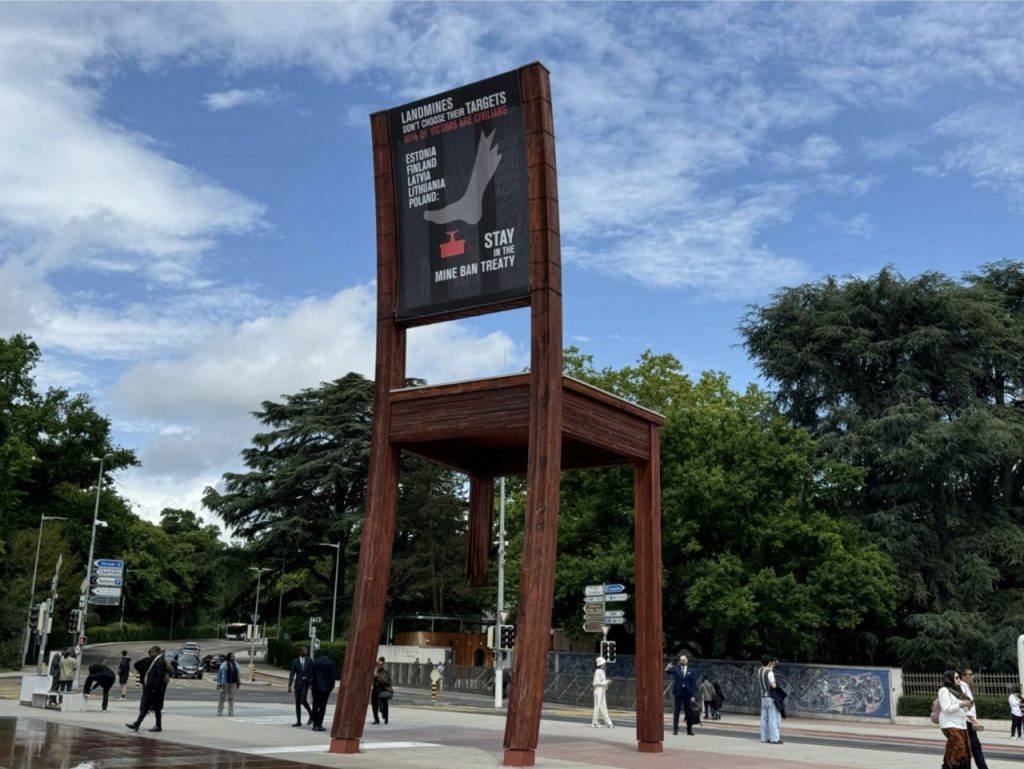
In this new context, civil society actors play a crucial role. Advocacy networks such as the International Campaign to Ban Landmines (ICBL) mobilized against Finland’s withdrawal, staging high-profile demonstrations, including painting the Broken Chair monument outside the UN Palais des Nations in Geneva, Switzerland. NGOs historically set normative standards by shaping the public discourse, which delegitimizes such rearmament efforts.
This role is also instructive, as civil society can directly shape policy creation and implementation. When the Ottawa Treaty was negotiated in the 1990s, NGOs like the ICBL and the ICRC directly shaped the drafting and adoption. The organization helped to secure over 40 necessary ratifications in just 10 months, setting the record as the fastest treaty to ever enter into force.
There is tremendous potential for lasting humanitarian policies when NGO and public pressure campaigns triumph. Such sustained campaigns lessen the political burdens of securing humanitarian policies and can help shape the global security consensus. They set the moral agenda for politicians and can produce the public support needed for sustained political will. As ICBL director Tamar Gabelnick stated regarding Finland’s withdrawal, “Returning is not a show of strength — it is a sign of weakness and desperation, contrary to international humanitarian law.” NGOs and public responses will be vital in levying critiques of the decision and dissuading other nations from following Finland’s path.
Coalitive Potential
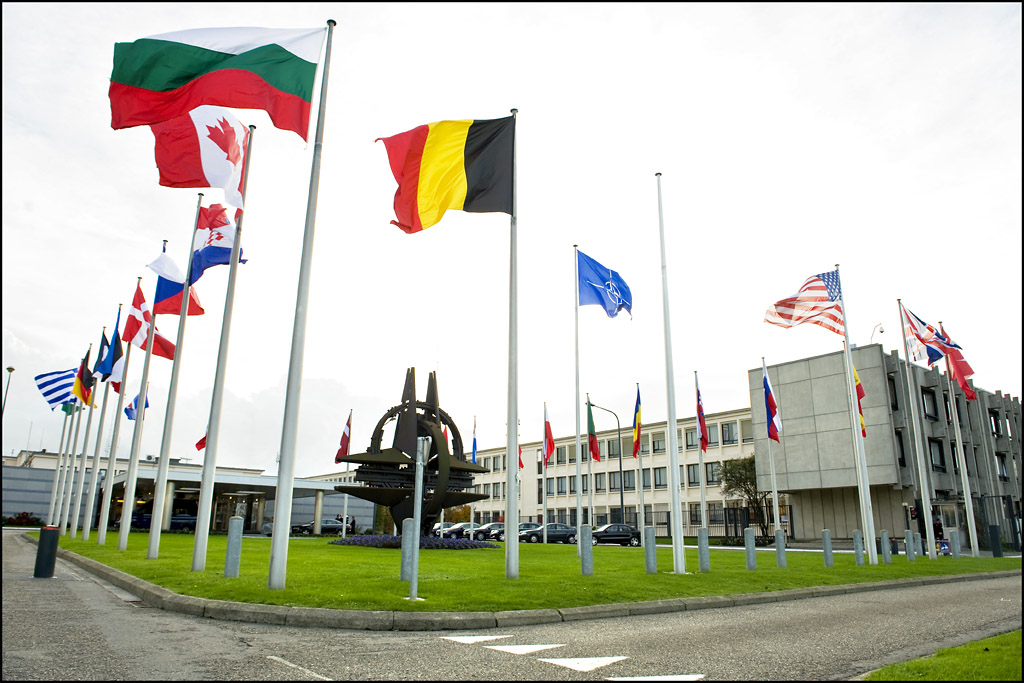
Despite conventional disarmament challenges, the Nordic region continues to lead in nuclear deterrence and coalition security frameworks, which align actors toward shared security goals. NATO membership provides small Nordic states with new avenues for cooperative security commitments and diplomacy. Rather than undermining disarmament, regional cooperation offers the mechanisms for maintaining credible defense while sustaining multilateral norms. This could present both a viable and economic alternative to withdrawal from the Ottawa Treaty and similar frameworks.
The Stockholm Initiative for Nuclear Disarmament, for example, convened sixteen non-nuclear SMPs to advance the objectives of the Treaty on the Non-Proliferation of Nuclear Weapons (NPT), reaffirming Nordic bridge-building capacity and commitment to international law. The initiative meets annually, which provides a reliable forum for regional alignment.
Future leadership in disarmament will require reframing security. Norway’s humanitarian disarmament strategy for 2024-2029 exemplifies a “human-centered” approach in which regional and multi-stakeholder leadership converge to advance peace. Nordic Defense Cooperation (NORDEFCO) aims to harmonize political and military responses, allocating 13 billion euros toward long-term defense strategy and integrating 20,000 ground, air, and sea personnel in joint exercises such as Nordic Response 2024.
Similar initiatives demonstrate how security and disarmament commitments can coexist, even strengthening deterrence, such as commitments to early-warning mechanisms and joint aerial force integration. The initiative reduces the economic and material burden of security development and deployment and eliminates the burdens of gathering intelligence on potential threats that a single nation could face, which takes up time and diminishes resources. The robust and pragmatic potential of NORDEFCO’s security approach could be a viable avenue for global SMPs to form similar regional compacts.
The Strategic landscape must evolve beyond militarization or isolationism. The current global arms doctrine is increasingly anachronistic and endangers long-term global peace. Nordic SMPs have a unique opportunity to advance humanitarian disarmament and demonstrate the influence small powers can have in shaping the global approach to arms leadership.
The Nordic region represents a broad strategic example for SMPs globally. Despite recent setbacks in conventional disarmament in the Baltic region, like Latvia and Finland’s proposed withdrawals, the leadership and bridge-building capacity of Nordic SMPs represent a viable alternative to further backsliding from legal and ethical frameworks.
For a more secure future, Nordic SMPs must reorient their security paradigm from short-term militarism into resilient, realistic coalitions. By integrating with NGOs and with each other, SMP coalitions can strengthen international humanitarian law through sustained investment in defense diplomacy, setting the model for a more secure future.